
Johnson Controls offers a diverse range of thermostats, blending style and functionality. Recent innovations, like the LUX CS1, prioritize user-friendly control and smart home integration.
These thermostats cater to various needs, from basic manual operation to advanced scheduling and remote access via mobile applications, enhancing home comfort.
What are Johnson Controls Thermostats?
Johnson Controls thermostats represent a commitment to both comfort and energy efficiency within the modern home. They range from traditionally styled, manually controlled units to sophisticated, Wi-Fi enabled smart thermostats like the LUX CS1. These devices regulate heating and cooling systems, maintaining desired temperatures and optimizing energy usage.
Recent models, acquired through the purchase of smart thermostat makers, emphasize ease of use, featuring intuitive interfaces and mobile app control. They offer features such as programmable schedules, geofencing, and integration with smart home ecosystems like Ezlo, providing homeowners with greater control and convenience.
Why Choose a Johnson Controls Thermostat?
Johnson Controls thermostats offer a compelling blend of style, functionality, and smart technology. The LUX CS1, for example, stands out as a stylish option, even without extensive advanced features. A key benefit is compatibility; the CS1 is designed for homes lacking a common “C-wire,” simplifying installation.
Beyond ease of installation, these thermostats provide convenient control through intuitive apps and programmable schedules. Integration with platforms like Ezlo unlocks smart home automation, while energy-saving modes contribute to lower utility bills. Choosing Johnson Controls means investing in reliable comfort and modern convenience.
Understanding Your Thermostat Model
Johnson Controls thermostats vary in features, from basic manual controls to advanced Wi-Fi enabled models with app integration and customizable scheduling options.
Identifying Your Specific Model Number
Locating your Johnson Controls thermostat’s model number is crucial for accessing the correct user manual and support resources. The model number is typically found on a sticker located in one of several places.
Check the back of the thermostat faceplate after gently removing it from the wall plate. Alternatively, look inside the battery compartment, if your model uses batteries. Some models display the number on the side of the unit.
Having this number readily available streamlines troubleshooting, ensures compatibility with accessories, and unlocks access to specific features detailed in your thermostat’s documentation.
Key Features Across Different Models
Johnson Controls thermostats boast a range of features, varying by model. Core functionalities include manual temperature control and programmable schedules for energy savings. Newer models, like the LUX CS1, emphasize app-based remote access and control.
Smart features such as geofencing automate temperature adjustments based on your location. Many models support integration with smart home platforms like Ezlo, expanding automation possibilities.
Display clarity, touchscreen capabilities, and vacation modes also differentiate models, catering to diverse user preferences and home automation needs. Understanding these distinctions helps select the ideal thermostat.
Thermostat Compatibility: Checking Your System
Ensuring compatibility is crucial before installing a Johnson Controls thermostat. A key consideration is the presence of a “C-wire” (common wire), which provides continuous power. Models like the Lux CS1 are designed for systems without a C-wire, simplifying installation in older homes.
Verify your heating/cooling system’s voltage (typically 24V). Confirm compatibility with your system type – forced air, heat pump, or radiant heat. Consulting a professional HVAC technician is recommended if unsure about your wiring or system configuration.
Incorrect installation can damage your system or the thermostat.

Initial Setup and Installation
Begin by carefully powering on your Johnson Controls thermostat and following the on-screen prompts for basic configuration, ensuring a smooth start to operation.
Powering On and Basic Configuration
Upon initial power-up, your Johnson Controls thermostat will guide you through a series of essential configuration steps. The display will illuminate, prompting you to select your preferred language and date/time settings.
Carefully follow the on-screen instructions to accurately input this information. Next, the thermostat will likely ask about your heating and cooling system type – accurately identifying this is crucial for optimal performance.
You may also be prompted to set a system mode (heat, cool, auto, or off). Take your time during this process, as correct initial setup ensures efficient and comfortable climate control.
Connecting to Wi-Fi
To unlock smart features, connecting your Johnson Controls thermostat to Wi-Fi is essential. Access the thermostat’s settings menu, typically through the touchscreen or buttons, and navigate to the ‘Network’ or ‘Wi-Fi’ section.
The thermostat will scan for available networks; select yours from the list and enter your password when prompted. Ensure your Wi-Fi router is functioning correctly and within range.
A successful connection will be indicated on the display. This enables remote control via the mobile app and access to advanced features like software updates and smart home integration.
Mobile App Download and Account Creation
To fully utilize your Johnson Controls thermostat’s capabilities, download the corresponding mobile app – often named “LUX” for newer models – from the App Store (iOS) or Google Play Store (Android).
Once installed, launch the app and follow the on-screen instructions to create an account. You’ll typically need to provide an email address and create a secure password.
During account setup, the app will guide you through pairing your thermostat. This usually involves entering a unique code displayed on the thermostat’s screen, granting app control.

Navigating the User Interface
Johnson Controls thermostats feature intuitive displays with clear icons. Touchscreen models offer direct control, while others utilize buttons for menu navigation and settings adjustments.
Display Overview and Icons
Johnson Controls thermostat displays typically showcase the current temperature, setpoint temperature, and operating mode (heat, cool, auto, off). Common icons indicate Wi-Fi connectivity status, battery level, and fan operation. A flame icon signifies heating is active, while a snowflake represents cooling.
Home/Away modes are often denoted by house or person icons, respectively. Vacation mode may be indicated by a suitcase or palm tree. Some models display outdoor temperature or weather forecasts. Understanding these icons allows for quick assessment of your system’s status and efficient adjustments to maintain desired comfort levels. Refer to your specific model’s manual for a detailed icon glossary.
Menu Options and Settings
Johnson Controls thermostats offer a range of menu options accessible via touchscreen or buttons. Core settings include temperature scale (Fahrenheit/Celsius), date and time configuration, and system mode selection. Users can adjust heating and cooling setpoints, create schedules, and configure fan control options (auto, on).
Advanced settings often encompass Wi-Fi network management, display brightness, and geofencing parameters. Energy-saving features, like smart recovery and adaptive learning, can be customized. Vacation mode setup and smart home integration options (Ezlo) are also typically found within the menu structure. Detailed explanations are available in the user manual.
Touchscreen Controls (if applicable)
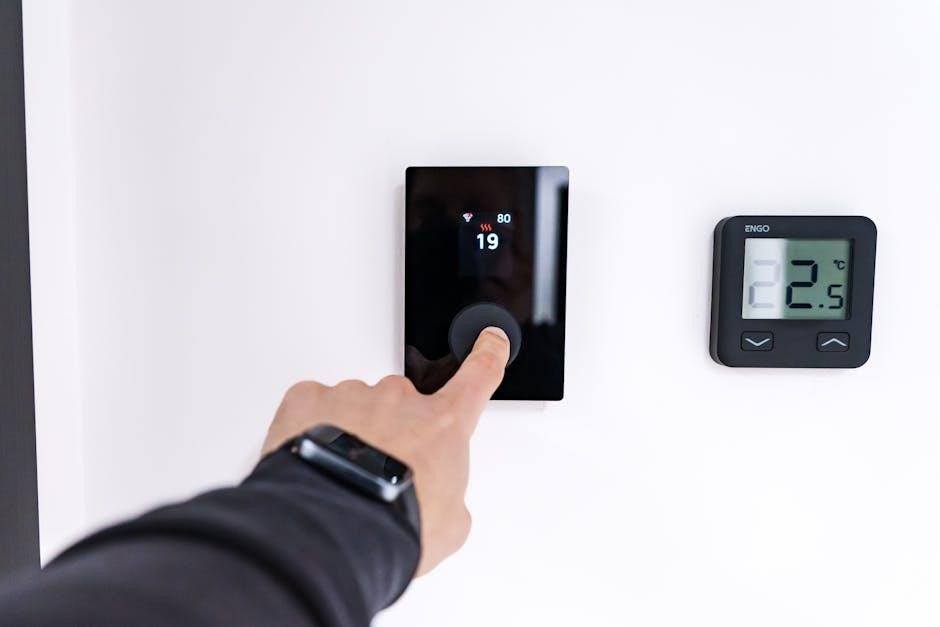
Johnson Controls thermostats with touchscreen displays provide intuitive control. Navigation typically involves swiping and tapping. The main screen displays current temperature, setpoint, and operating mode. Adjusting temperature is often achieved by directly tapping up or down arrows.
Accessing menus usually requires a dedicated button or a swipe gesture. Touchscreen responsiveness and sensitivity can be adjusted within settings. The interface prioritizes ease of use for manually controlling temperature, schedules, and home/away features. Refer to the user manual for specific gesture controls and touchscreen functionalities.

Programming Your Thermostat
Johnson Controls thermostats allow customized scheduling for optimal comfort and energy savings. Utilize the LUX app to easily set daily or weekly temperature preferences.
Setting a Basic Schedule
Establishing a basic schedule with your Johnson Controls thermostat is straightforward using the LUX app. Begin by selecting the “Schedule” option within the app’s interface. You’ll typically define periods like “Wake,” “Leave,” “Return,” and “Sleep,” assigning desired temperatures to each.
For each day of the week, you can set a specific temperature for each period. Consider lower temperatures while away or asleep to maximize energy efficiency. The app provides a visual representation of your schedule, allowing for easy adjustments. Remember to save your changes after configuring each day’s settings. This simple process ensures consistent comfort and potential cost savings.
Creating Customized Schedules for Different Days
Johnson Controls thermostats excel in schedule flexibility. Within the LUX app, after establishing a basic schedule, you can tailor settings for individual days. Select a specific day – for example, Saturday or Sunday – and modify the temperature settings for each period (“Wake,” “Leave,” etc.).
This is ideal for weekends with altered routines. Perhaps you prefer a warmer temperature on Saturday mornings or a later “Return” time on Sundays. The app allows independent control for each day, ensuring optimal comfort aligned with your lifestyle. Save each day’s customized schedule individually to maintain personalized climate control throughout the week.
Using Geofencing for Automated Control
Johnson Controls thermostats, when paired with the LUX app, offer geofencing capabilities for automated energy savings. This feature utilizes your smartphone’s location to adjust the temperature. Define a virtual “fence” around your home; when you exit this zone, the thermostat automatically switches to an energy-saving “Away” mode.
Conversely, as you approach home, the thermostat anticipates your arrival and returns to your preferred “Comfort” setting. This eliminates wasted energy heating or cooling an empty house and ensures a welcoming temperature upon your return. Configure geofencing within the app’s settings, specifying the radius of the geofence.
Advanced Features and Settings
Johnson Controls thermostats unlock smart home integration with platforms like Ezlo, alongside energy reports and customizable vacation modes for optimal control.
Smart Home Integration (Ezlo, etc.)
Johnson Controls thermostats seamlessly integrate into broader smart home ecosystems, notably through partnerships with platforms like Ezlo Innovation. This connectivity allows for centralized control of your heating and cooling systems alongside other smart devices.
Users can create automated scenes and routines, triggering temperature adjustments based on events or schedules within the Ezlo environment. This integration extends beyond simple remote access, enabling sophisticated energy management and enhanced home automation possibilities. Explore the Ezlo app to discover compatible devices and customize your smart home experience with your Johnson Controls thermostat.
Energy Saving Modes and Reports
Johnson Controls thermostats offer several features designed to optimize energy consumption and reduce utility bills. These include pre-programmed energy-saving modes, allowing for automatic temperature setbacks during periods of low occupancy or overnight.
Many models also provide detailed energy usage reports, accessible through the mobile app, offering insights into your heating and cooling patterns. Analyzing these reports helps identify areas for improvement and fine-tune your schedule for maximum efficiency. Utilizing these features contributes to a more sustainable lifestyle and lower energy costs.
Vacation Mode Setup
Johnson Controls thermostats simplify energy conservation during extended absences with a dedicated Vacation Mode. This feature allows you to set a specific temperature to maintain while you’re away, preventing frozen pipes in winter or excessive humidity in summer.
Access Vacation Mode through the thermostat’s menu or the mobile app, specifying the start and end dates of your trip. The system will automatically adjust to the set temperature upon your departure and return to your regular schedule upon your arrival, ensuring comfort and efficiency.

Troubleshooting Common Issues
Common problems include Wi-Fi connectivity, inaccurate readings, and display malfunctions. Refer to the manual or online resources for guided solutions and support options.
Thermostat Not Connecting to Wi-Fi
If your Johnson Controls thermostat struggles to connect to Wi-Fi, first ensure your home network is functioning correctly with a stable internet connection. Double-check the Wi-Fi password entered during setup within the LUX app, verifying accuracy.
Restart both your thermostat and your router; this often resolves temporary connectivity glitches. Confirm the thermostat is within range of your Wi-Fi signal. If issues persist, consult the user manual for specific troubleshooting steps, including potential factory reset instructions. Explore the Johnson Controls support website for further assistance and FAQs related to Wi-Fi connectivity.
Inaccurate Temperature Readings
If your Johnson Controls thermostat displays inaccurate temperature readings, verify it isn’t directly exposed to sunlight, drafts, or heat-generating appliances. These external factors can significantly skew the sensed temperature. Ensure the thermostat is securely mounted to the wall, preventing air circulation behind the unit.
Calibrate the temperature within the thermostat’s settings, adjusting it to match a known accurate thermometer. If the problem continues, consult the user manual for advanced calibration options or contact Johnson Controls support for further assistance. A faulty sensor might require professional evaluation.
Display Problems and Solutions
If your Johnson Controls thermostat’s display is blank or exhibiting issues, first check the power source. For battery-powered models, replace the batteries with fresh ones. If hardwired, verify the breaker hasn’t tripped. A dim display might indicate low battery power, even if the unit appears functional.
Try resetting the thermostat by removing power for a few minutes, then restoring it. If the display remains problematic, consult the user manual for specific troubleshooting steps or contact Johnson Controls customer support. A failing display may necessitate thermostat replacement.

Maintenance and Care
Regular cleaning with a soft cloth ensures optimal performance. Battery-powered models require periodic replacements, while software updates maintain functionality and security.
Cleaning Your Thermostat
Maintaining a clean thermostat is crucial for accurate readings and optimal performance. Before cleaning, always power off the thermostat to avoid any electrical issues or accidental adjustments. Use a soft, dry cloth to gently wipe the display and the surrounding casing.
Avoid using abrasive cleaners, solvents, or excessive moisture, as these can damage the sensitive electronic components. For stubborn dirt or smudges, lightly dampen the cloth with water, ensuring it’s wrung out thoroughly. Pay attention to the vents, carefully dusting them to ensure proper airflow. Regular cleaning, approximately every few months, will help keep your Johnson Controls thermostat functioning reliably for years to come.
Battery Replacement (if applicable)
If your Johnson Controls thermostat utilizes batteries, it’s essential to replace them promptly when the low battery indicator appears on the display. Refer to your specific model’s documentation for the correct battery type and quantity required. Typically, thermostats use standard AA or AAA alkaline batteries.
Power off the thermostat before opening the battery compartment, usually located on the side or back of the unit. Carefully remove the old batteries and insert the new ones, ensuring correct polarity (+ and -). A fresh set of batteries will restore full functionality and prevent inaccurate temperature readings or system disruptions.
Software Updates and Firmware
Maintaining up-to-date software and firmware on your Johnson Controls thermostat is crucial for optimal performance and access to the latest features. Updates often include bug fixes, security enhancements, and improved compatibility with smart home systems like Ezlo.
The thermostat typically checks for updates automatically when connected to Wi-Fi. You can also manually initiate a check through the thermostat’s settings menu or the associated mobile app. Ensure a stable internet connection during the update process, and avoid interrupting power to the device. Following these steps guarantees a smooth and efficient update experience.

Safety Information
Always prioritize electrical safety when installing or maintaining your Johnson Controls thermostat. Disconnect power before any work, and consult a qualified electrician if needed.
Important Warnings and Precautions
Exercise extreme caution during installation and operation. Incorrect wiring can damage your HVAC system or the thermostat itself, potentially creating a fire hazard. Never attempt repairs beyond basic troubleshooting; always consult a qualified HVAC technician for complex issues.
Ensure the thermostat is installed in a location free from extreme temperatures, humidity, and direct sunlight. Do not expose the device to water or other liquids. Keep the thermostat away from flammable materials. Regularly inspect wiring for damage and replace as needed. Always follow local electrical codes and regulations.
Electrical Safety Guidelines
Prioritize safety when working with electrical connections. Always disconnect power to your HVAC system at the breaker box before beginning any installation or maintenance. Verify the power is off using a non-contact voltage tester. Use appropriately sized wiring and connectors, adhering to local electrical codes.
Never work with wet hands or in damp environments. If you are uncomfortable working with electrical wiring, immediately contact a qualified HVAC professional. Ensure all connections are secure and properly insulated to prevent shorts or shocks. Avoid overloading circuits and inspect wiring regularly for damage.
Resources and Support
Johnson Controls provides extensive online resources, including FAQs and detailed manuals. Direct customer support is readily available for assistance with setup and troubleshooting.
Johnson Controls Website and FAQs
Johnson Controls’ official website serves as a central hub for thermostat support, offering a comprehensive library of user manuals for various models. These manuals detail installation procedures, programming instructions, and troubleshooting steps. A dedicated FAQs section addresses common user queries, providing quick solutions to frequently encountered issues.
The website also features helpful videos demonstrating key features and functionalities. Users can easily search for specific information using keywords or model numbers. Furthermore, the site provides access to software updates and firmware downloads, ensuring optimal thermostat performance. Regularly checking the website ensures access to the latest support resources and product information.
Customer Support Contact Information
Johnson Controls provides multiple avenues for customer support regarding their thermostats. While specific contact details may vary, their official website typically lists a dedicated support phone number and email address for technical assistance. Many users also find helpful support through online forums and communities dedicated to smart home technology.
For immediate assistance, checking the website’s “Contact Us” section is recommended. Additionally, Ezlo Innovation, a partner of Johnson Controls, may offer support for integrated systems. Retaining your thermostat’s model number when contacting support will expedite the assistance process, ensuring a swift resolution to any issues.
Leave a Reply
You must be logged in to post a comment.